
Duration of the Thesis: 6 months
Completion: July 2012
Tutor: A. Scheider
Examiner: Prof. Dr.-Ing. Volker Schwieger
A total station is an electronic / optical instrument used in modern surveying, which integrates an electronic theodolite with an electronic distance meter (EDM) to read horizontal and vertical angles and distances from the instrument to the targets.
With the rapid development of surveying technology, the robotic total stations with the functionality of automatic target tracking have been occurred and open up a new chapter for surveying area. The robotic total stations allow the operator to control the instrument from a distance via remote control, by which the need for an assistant is eliminated and a variety of positioning and navigation tasks can be performed efficiently with precise accuracy.
Measuring angles and distances by total stations is one of the core competencies of any geodesist. These quantities are used to determine coordinates for static as well as kinematic applications. In the process of measuring, the demand for more precise, more accurate, more reliable, and more efficient instruments will never end. However, the survey engineering projects become larger and more challenging with respect to time, costs and quality, bringing stronger requirements for total stations beyond highest precision and accuracy and also involving reliability, robustness, automation, efficient operation, long service intervals and the reduced maintenance costs, all of which are significant factors for the efficient project completion.
Leica TS30 and Trimble SPS930, as representatives of a new generation of total stations in the world, are equipped with advanced technologies and accessories, and thus deliver the great capabilities of high-accuracy, efficiency and reliability. Speaking of the high accuracy, Leica TS30 can achieve an angular accuracy of 0.15mgon and distance accuracy of 0.6 mm + 1 ppm (precise) and 3 mm + 1 ppm (tracking) while Trimble SPS930 can reach an angular accuracy of 0.3mgon and distance accuracy of 2 mm + 2 ppm (standard) and 4 mm + 2 ppm (Tracking). Thus the two total stations enable the new applications in the field of surveying, e.g. machine guidance. However, whether they can stand the challenges and possess high performances in the diverse applications need to be further tested. Furthermore, by comparison of two total stations from two different companies, the advantages and disadvantages according to diverse measuring requirements should be discovered, in order to implement different applications with better performances.
The main content of the thesis are listed as follows:
|
| Figure 1: The investigation of motorized movement in straight track |
 |
| Figure 2: The investigation of motorized movement in elliptical track |
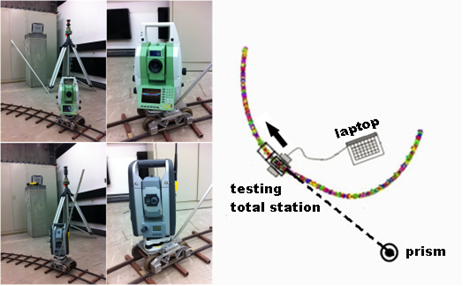 |
| Figure 3: The investigation of possibility of moving total stations Leica TS30 and Trimble SPS930 |
Firstly, the automatic target recognition of the total stations Leica TS30 and Trimble SPS930 can fulfill the requirements concerning linearity, repeatability, stability and also tracking a target with cooperating with all-directional prisms in the process of measurements. For Leica TS30, first of all, the different measuring directions are not affecting the accuracy of measurements. And the standard deviation of repeatability is 0.1 mgon (horizontal angle), 0.14 mgon (vertical angle) and 0.4 mm (distance). Moreover, the total stations can track the target efficiently according to different moving trajectories. For Trimble SPS930, the repeatability and ability of tracking a target can be guaranteed with achieving fine accuracy (Passive target, distance: 0.8537mm, horizontal angle: 15.9 mgon, vertical angle: 2.9 mgon. Active target, distance: 0.8373 mm, horizontal angle: 8.0 mgon, vertical angle: 17.5 mgon).
Secondly, compensator of Leica TS30 can function well in terms of different velocities, trajectories and figurations. But no predefined standard commands or programs can be achieved by Trimble SPS930 to get the parameters of compensator calibration errors.
Thirdly, for Leica TS30, the ATR and LOCK mode can achieve mm accuracy and the quality of the ATR and LOCK mode are similar in static mode. For Trimble SPS930, the LOCK mode with passive and active target can both reach mm accuracy. Moreover, LOCK mode with active target can achieve good quality than with passive target, especially in horizontal angle and distance. But in terms of vertical angle, quality of passive target seems to be better. Besides, Results by using manual mode are worst because the accuracies in manual mode are two or three times more than those in ATR and LOCK mode.
Fourthly, generally speaking, for two total stations, tracking target in the straight or elliptical track can achieve accuracy in millimeter level and stability. Furthermore, Leica TS30 can achieve better quality than Trimble SPS930 in normal kinematic mode (see figure 4, 5, 6, 7 and table 1).
 |
| Figure 4: x-y-z coordinate values of passive target with different velocity in position 1, 2 and 3 of the straight track (Leica TS30) |
 |
| Figure 5: x-y-z coordinate values of passive target with different velocity in position 1, 2 and 3 of the straight track (Trimble SPS930) |
 |
| Figure 6: x-y-z coordinate values of active target with different velocity in position 1, 2 and 3 of the straight track (Trimble SPS930) |
 |
| Figure 7: x-y coordinate values in the elliptical track (Leica TS30 (1) and Trimble SPS930 (2, 3, 4)) |
RMS |
In straight track |
In elliptical track |
Leica TS30 |
1.7 mm |
4.5 mm |
Passive |
3.4 mm |
8.7 mm |
Active |
1.8 mm |
8.6 mm |
| Table 1: RMS determined by using Leica TS30 and Trimble SPS930 in straight track and elliptical track | ||
In addition, all z- coordinate values in normal kinematic mode are not so good, as some stochastic large errors occur in the results measured by Leica TS30 and Trimble SPS930 is sensitive to vibration of movement and in long or too close distances, the errors easily happen.
Fifthly, the target-loss can happen easily in tracking mode when other prisms occur or the target is covered. However, generally speaking, Trimble SPS930 can behave relatively better than Leica TS30 in front of disturbance as it can continue measurements when the disturbance is disappeared.
At last, the movement of total station without leveling can be realized with Leica TS30 (see figure 8) and deserves further investigation to apply the robotic total stations in the new fields such as hydrographic field.
 |
| Figure 8: x-y coordinate values of moving a total station measured by different modes by (a) LABVIEW controlling program and (b) automatic measurements of total station |